
Rab Laboratory
-

How do raincoats work?
How does it keep you dry? How does it breathe? Learn what qualities are most useful for your next mountain adventure.
-

How does insulation keep you warm?
Discover the differences and similarities between down and synthetic insulation and learn how each works to keep you warm.
-

How to Build a Sleeping Bag
When it comes to sleeping bag design, there's a lot to unpack. Find out the details of our designs to help you select your next sleeping bag.


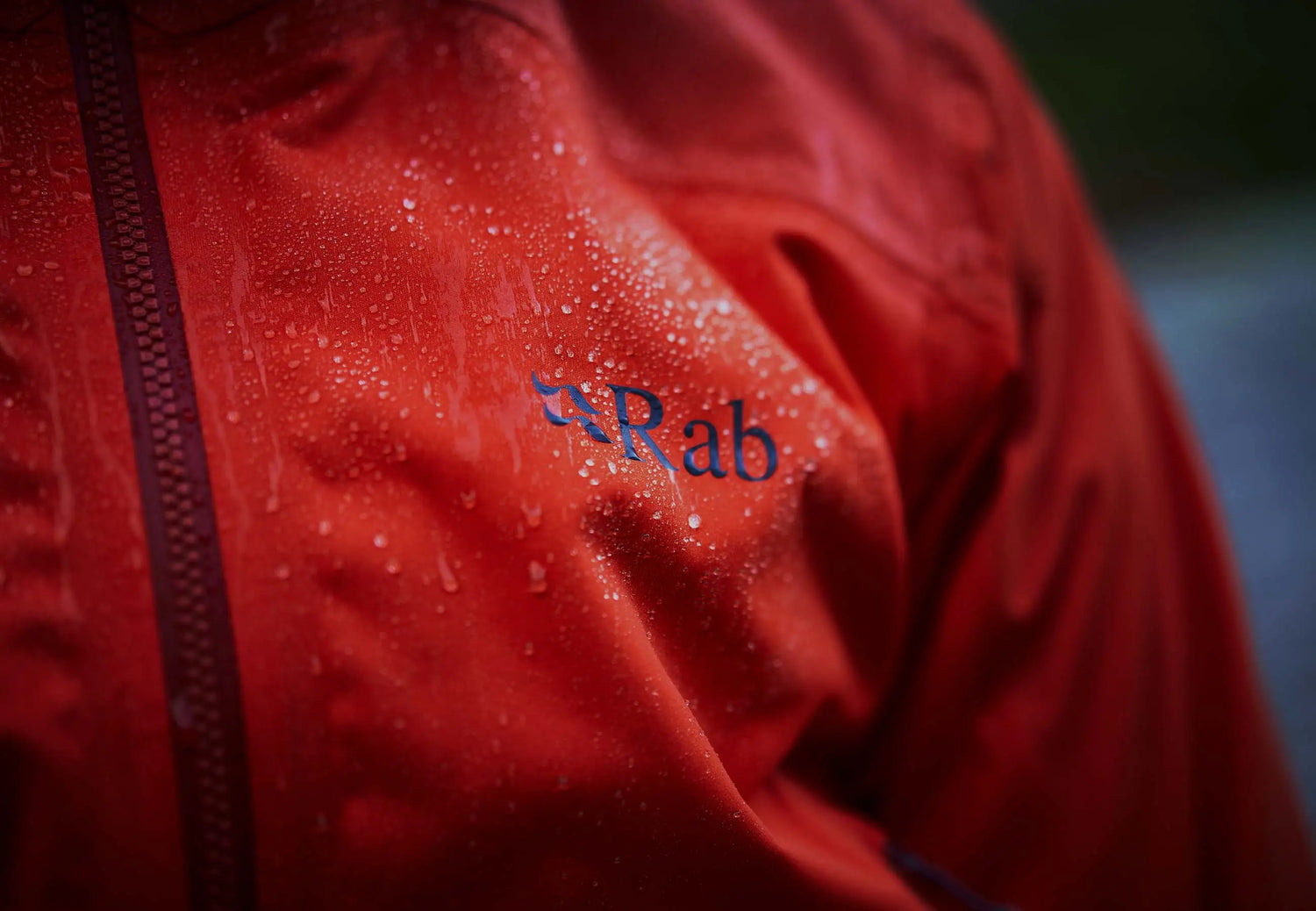
Waterproofing: From Then to Now.
In the past, fabrics were coated with oils and waxes to repel water. But these were often heavy on the fabric and needed to be constantly reapplied.
Modern waterproof fabrics use a thin waterproof membrane. These can be designed to allow some moisture, such as sweat, to pass through them, resulting in a more comfortable garment.
A durable water repellent (DWR) treatment is often applied to the outer face fabric to help maintain waterproofness and breathability and to ensure the membrane works as efficiently as possible. But we’ll get to that later.
How to Create a Waterproof Barrier
-

Waterproof Coatings
The first waterproof and breathable barrier was coated onto a piece of fabric and is generally the simplest way to create a waterproof fabric.
A liquid layer is applied similarly to how you would apply paint with a roller to form a flexible and durable layer.
-

Waterproof laminates
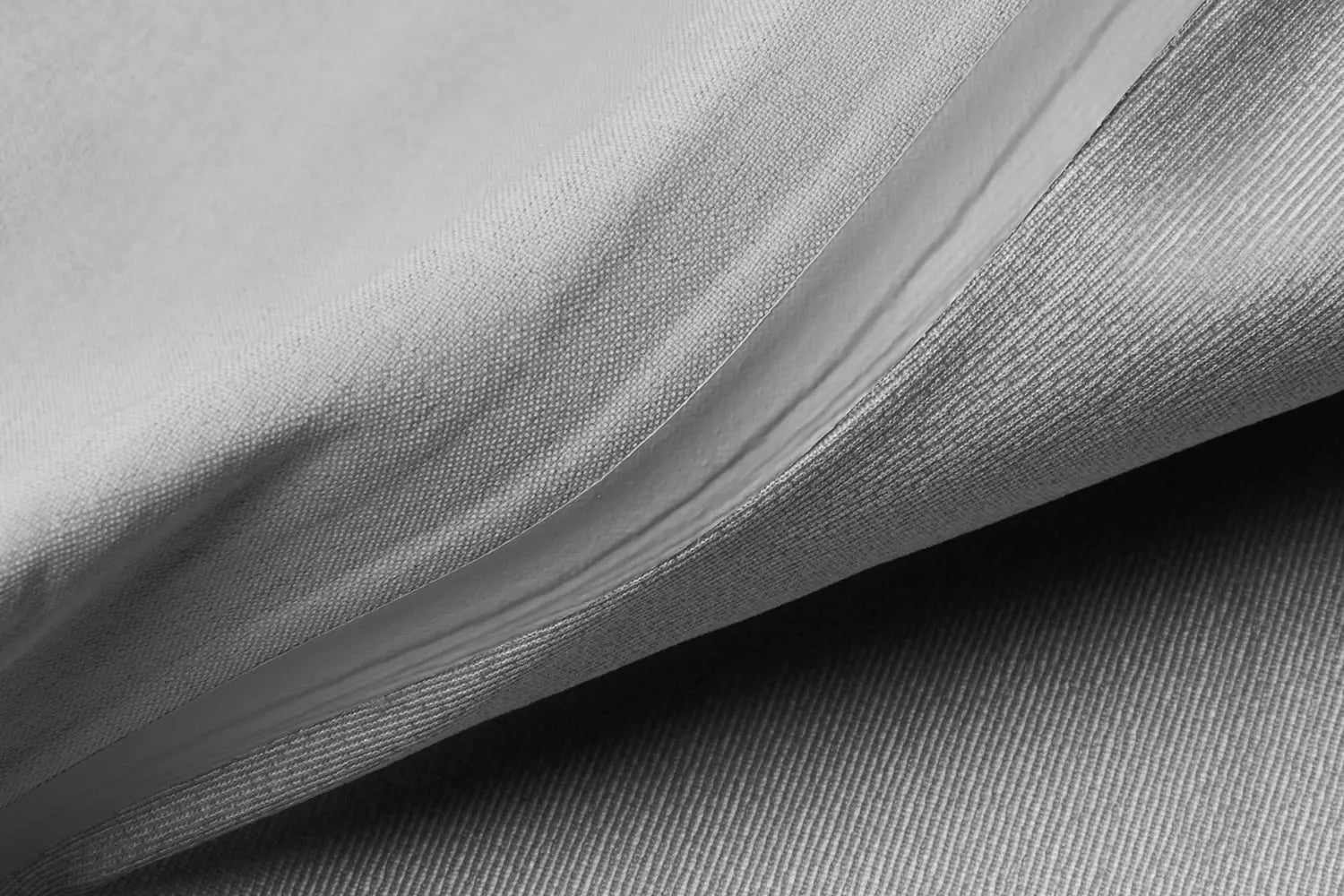
Laminates are thin membranes manufactured separately as a sheet of material that is then glued or bonded (laminated) to the face fabric.
It is important to select and combine the right membrane with the correct fabric and bonding process for the intended end-use of the textile.
-

These waterproof barriers are incredibly thin. At Rab we use membranes ranging between 7 and 30 microns thick; for reference, a human hair strand is around 100 microns.
Thinner membranes will allow for greater breathability for fast and light activities. Thicker membranes provide a higher level of durable waterproofing.


How to Build a Raincoat
-

2 coats
What is it?
This is the simplest construction with a laminated or coated membrane applied to a single layer of fabric.Why is it useful?
2-layer waterproof fabrics are typically the lightest, ideal for situations where low weight and small pack size are crucial.Where do we use it?
We use this method in our shelters and tents, where there is no direct abrasion on the membrane. -

2.5 layers
What is it?
A 2.5-layer construction is similar to a 2-layer construction with the addition of a light layer or print, which is applied to the surface of the membrane.Why is it useful?
This additional coating adds durability and protection without affecting breathability. It also provides softness and is a waterproof fabric with an excellent quality-price ratio.Where do we use it?
We use this method in some of our garments that are used in situations where weight, packability, and breathability take precedence over durability. -

3-ply
What is it?
In 3-layer construction, the membrane is sandwiched between an outer fabric and an extremely light inner fabric.Why is it useful?
The third layer offers more comfort, durability, and protection, but these are the most complex waterproof fabrics to manufacture.Where do we use it?
3-layer construction is commonly found in Rab Shell garments. This fabric allows us to create resistant and durable garments that are still lightweight and relatively compact.


How durable is my rain jacket?
-

Durability Factors
- The type of material and fabrics used (e.g., nylon or polyester)
- The type of membranes used (e.g., PU, PE, or ePTFE)
- The denier and weight of the face fabric used
- The construction method of the face fabric (e.g., woven or knitted)
-

Durability tests in the laboratory
The Martindale machine provides an industry-standard test. Its beauty lies in its simplicity, subjecting a fabric sample to a repeated rubbing motion that simulates prolonged wear.
The machine can simulate the pressure an item will have on the fabric, such as backpack straps, or the constant abrasion of carrying a 6 kg backpack.
-

Field durability testing
Our kit is not fully approved for use until it is seen in action in the places for which it is designed. From winter in the Scottish mountains to expeditions in the Himalayas, our test team provides us with real-world evaluation to complement our lab tests.
In response to our designers, garment technologists, and fabric specialists team, testers subject our gear to rigorous use in the mountains, ensuring that all aspects, from construction to fit, perform correctly.


How waterproof is my raincoat?
-

Water pressure changes your equipment faces on every adventure

What is breathability?
When we refer to gear as ‘breathable’ we are referring to the extent to which it allows moisture to escape.
Even during light activity, the body responds by sweating. In a ‘non-breathable’ garment there is no way for this moisture to escape. It builds up on the skin and in the fabric as condensation.
Trapped inside your jacket, this moisture acts as a thermal conductor. It transfers heat away from your body almost 25 times faster than dry clothing. This feels very uncomfortable, chilling, and in extreme environments it can lead to hypothermia.
A breathable garment will allow moisture to escape through the membrane. It reduces the peaks and troughs of body temperature and keeps you comfortable for longer.
How can a membrane be waterproof and breathable?
-
Microporous Membranes
A microporous membrane has millions of tiny holes that are large enough to allow water vapor to pass through, but too small for water droplets to enter.
What is it made of?
In waterproof apparel, these membranes are generally made of PTFE or PU, in a network of small, interconnected pores.How does it work?
Individual water molecules (around 700 times smaller than the pores) in sweat vapor can pass through the membrane.Clusters of water molecules (around 20,000 times larger than the pores) in raindrops are too large to pass through the membrane.
-
Hydrophilic Membranes
A hydrophilic (water-loving) membrane attracts moisture to its inner surface and then moves it to its outer surface.
What is it made of?
Often made of PU, this is a solid-state membrane with no microporous holes.How does it work?
You may have heard of osmosis back in your biology class days. This is exactly how a hydrophilic membrane works. Moisture from sweat is absorbed into the membrane and then diffused into the atmosphere on the other side.As you warm up and produce more sweat, the diffusion gradient increases. The membrane responds by increasing the rate of moisture transmission, working to equalize the water vapor balance on the inside and outside of your gear.
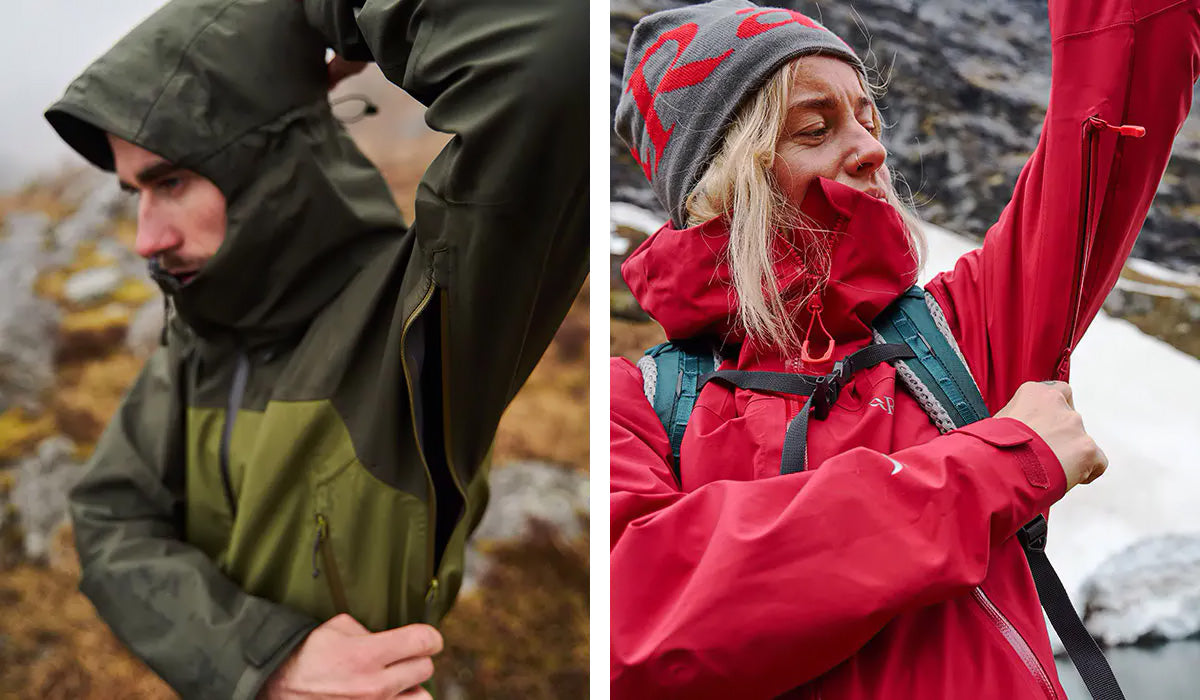
How breathable is my rain jacket?
Here’s where things get technical… You can measure the breathability of fabrics in a variety of ways in a lab.
Is it possible you’ve seen the MVTR rating quoted before? This refers to the moisture vapor transfer rate and is an industry-standard test. We also use the sweating guarded hot plate—no, it’s not some kind of French tabletop grill! It’s another industry-standard test that simulates the transfer of sweat through fabrics.
Does breathability mean comfort?
-

Measuring Breathability with MVTR
MVTR records the amount of evaporation through one square meter of fabric over a 24-hour period.
There are two types of MTVR test, inverted cup and upright cup, but the premise is the same. They calculate the change in weight created by the movement of moisture from one side of the fabric to the other.
This difference in weight is calculated after the test to give a moisture vapor transfer reading of grams per square meter of fabric over 24 hours. This describes how much sweat will pass through the fabric.
What should you look for?
Figures can range from less than 10,000 MVTR up to 40,000 MVTR.High MVTR = High breathability
Low MVTR = Low breathability
-

Measuring Breathability with RET
RET shows the level of resistance of the fabric to evaporation.
In this test, the fabric is placed on a porous metal plate. The plate is heated to a constant temperature of between 33 °C and 36 °C and water is channeled onto the metal plate to simulate sweat.
As water vapor passes through the fabric, it causes evaporative heat loss. The amount of energy required to keep the plate at a constant temperature is used to extrapolate an RET figure.
What should you look for?
The better the breathability, the lower the RET value.High RET = Low breathability
Low RET = High breathability


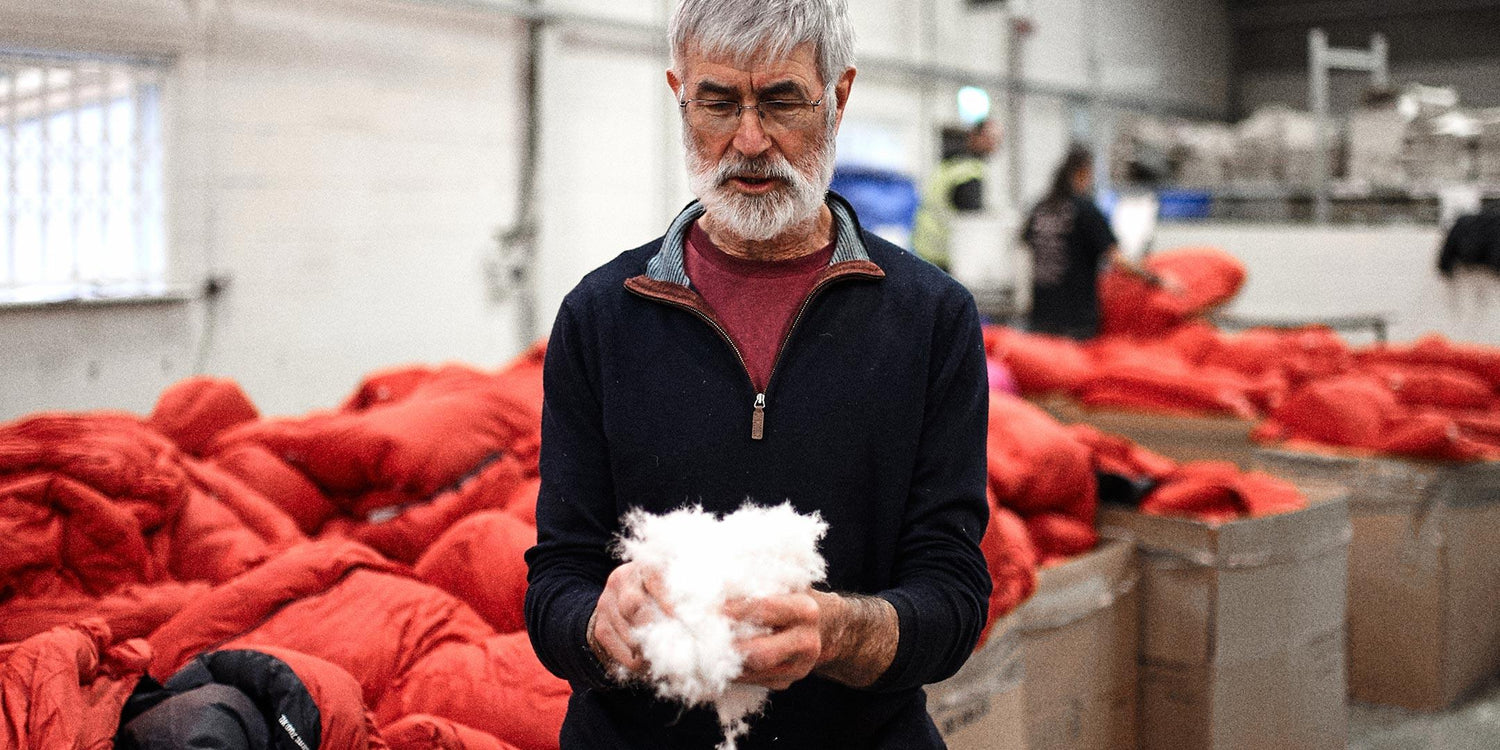
What Is Insulation and How Does It Work?
We use two types of materials in our gear to insulate you from the cold: duck or goose down and artificial synthetic fibers.
Both work the same way by trapping air within their structures. The down or synthetic fibers themselves don't keep you warm; it's their ability to effectively trap air and keep it still.
You'll find that air acts as an insulator in all sorts of places... In the walls of your home, in your mattress, or even in your takeaway coffee cup. Insulated gear typically uses down or synthetic insulation, though some products may use both in their construction.
Down and Synthetic
-

Marker
Down clusters are the fluffy clusters found underneath the harder exterior feathers of ducks and geese. If it's good enough to keep them warm, then it's good enough for us. what is down?
When people talk about down, they often refer to it as feathers. However, feathers are only a very small proportion of the insulation. We use much more down than feathers in our gear.
What's so good about down?
Down is made up of very fine fibers that provide the lightest and most efficient medium to trap and hold air in position.
This trapped air provides an incredibly efficient thermal barrier. Its performance is unrivalled by any other natural or synthetic equivalent. Individual down clusters expand (or loft) to fill an area that is vast in relation to their size. The volume of down is almost entirely made up of trapped air, so any down-filled gear remains incredibly light and compressible.
Down Cluster Ratio
This is the amount of down and feather mix found in your down clothing.
The higher the ratio, the more down the item contains.
For our duck down gear, we have a cluster ratio of 80:20, where there is a maximum of 20% feather content. For our goose down items, this ratio changes to 90:10, where the minimum down content is 90%.
The higher the down percentage, the better warmth-to-weight.
-

Synthetic
Xenair Alpine LightSynthetic insulation is completely man-made. It's usually created from polyester to form either sheet wadding or lofty (blown-in) structures that perform very similarly to down.
Filaments of different sizes are intertwined with each other to create air pockets that insulate you from the cold.
What’s good about synthetic insulation?
Synthetic insulation is tough and resilient. It’s lightweight, fast-drying, and remains effective in damp conditions. Synthetic sheet insulation can be especially useful for kit used in stop-and-start activities or fast ascents because it can be used with highly breathable fabrics. It’s designed to respond to your output, insulating or breathing to regulate your temperature in a wide range of conditions.
How is synthetic insulation made?
Generally, sheet insulation is a non-woven material. It’s produced using polyester fibres, which are interlinked to form a 3D net-like structure. This structure is held in place by binder fibres that are heat-activated (melted) so they bond at points where the fibres cross over to hold them in place.


