We Are Explorers: Manu Prats. Are you strong enough?
mountaingroupCompartir


We Are Explorers: Are you tough enough?
I don't remember if I read it in a book or saw it in a movie, but it has always fascinated me that a journey doesn't begin when you pack your bags, but when you first dream of it.
In my case, the trip to Madagascar began in 2007 after the radical opening of the “Hijos de la Pedri” route in the Tsaranoro valley by my inspiring friends Talo and Palan Martin. However, between 2007 and 2019, there was a great social, technological, and economic change in the region. The difference between my friends' tales and the reality of the Madagascar I was about to find was immense.

By Manu Prats | Professional Photographer

After a couple of meetings at Pedro Cifuente’s house collecting information, Pedro, José “Pin” Allende, and I decided to spend a month there. For the first part, we would go to the Tsaranoro valley for climbing and photo shooting. For the rest, we would cross the plateau to the west looking for the Indian Ocean and the wonders of Tsingy National Park. At first we were two teams of two, but some last-minute work issues made us a trio. This obviously complicated the climbing logistics, but the motivation was high. Pedro wanted to prepare for his next Patagonian expedition, and Pin was eager to capture some great shots for his portfolio.
We traveled from Madrid to Paris and from there to Antananarivo. Known locally as Tana, this is the most populated city on the island of Madagascar. The first known settlers were from Indonesia, so their native language is Malayo-Polynesian. After that, some migrated from Bantu in Africa. This makes it a mixture of African and Asian characters, but Persians and Arabs also settled on the island. Until independence in 1960, it was the Portuguese, Spanish, and English who influenced the place.
As with every good trip, there is always some helpful twist of fate. As we were discussing which can of tuna we would buy in a Tanas supermarket, two Spaniards approached us. They were Jaume and Silvia, both Spanish expats who had lived there for 14 years and owned the Indigo Be Madagascar (indigobe.com). They explained a lot about what to expect in Madagascar.

We had an eight-hour trip to Fianarantsoa and from there another four hours by 4x4 to the valley. The stories about the roads were still accurate, they hadn't changed much in twelve years. Getting out of Tana wasn't too bad, but from there to Fianarantsoa was a hell of bumps and animals. However, the expectation that we would find thousands of different species and rainforests at every turn soon faded. The reality of Madagascar is one of cattle pastures and rice fields, cleared of forests. It is an ocher landscape without original vegetation.
We were eager to reach Fianarantsoa where the adventure would begin. None of us could wait any longer once we saw the mountains in the distance. Just two weeks in the area would never be enough! The Tsaranoro Valley is a land of adventure thanks to its immensity and isolation. Everything there requires a lot of planning, effort, and logistics, and that's without taking into account the cattle mafias and the known violence in the vanilla fields.
Arriving at the Tsarasoa lodge was a mix of emotions, the first confirmation that Africa is a land of contrasts. There we met the owner, Gilles, a Frenchman who had abandoned everything for love, love for the valley and its walls, and for a Malagasy woman, of course. His kindness, his smile, and his ability to communicate in several languages gave us peace of mind, motivation, and good vibes. However, it was unsettling to see our luggage lowered from the truck by a group of natives. It gave me an idea of what it would have been like in colonial times.
That night we were exhausted. We sat at a table in the middle of nowhere in Africa ready to eat a simple meal of rice and local stew surrounded by beautiful tablecloths, cloth napkins, and sparkling cutlery. Gilles's clients are climbers, yes, but he knows there are some French tourists who appreciate a touch of luxury.
I don't think I'll ever forget that first meal, Pin definitely won't! We had bought a jar of sesame oil to season our food and I noticed Pin was using a lot on the rice. His stomach protested. The next morning, at breakfast, we laughed as he wondered if he had contracted malaria on his first day. In fact, he had discovered that an excess of sesame oil is much more dangerous than contracting malaria.

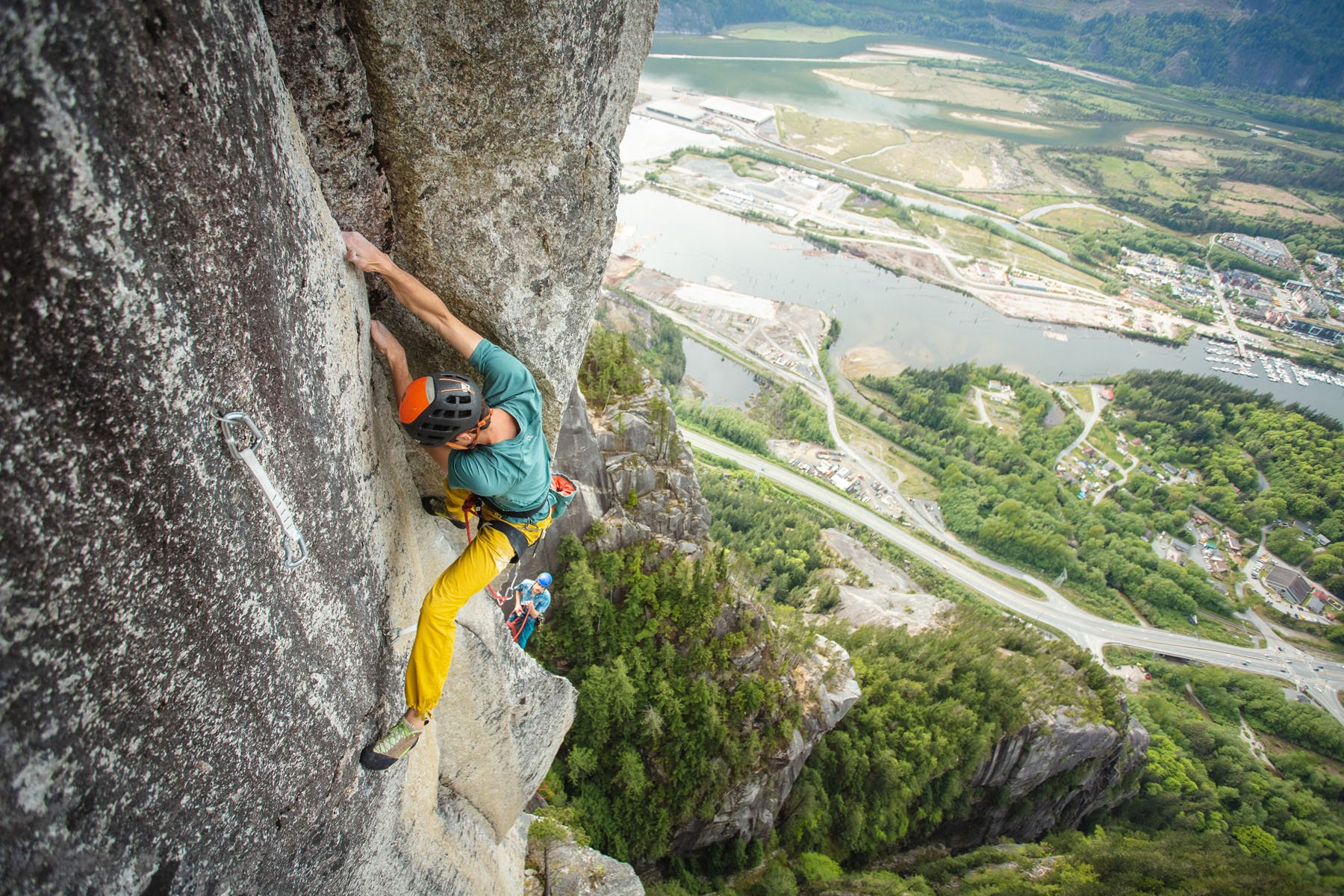
Pedro and I set off, there was no time to lose. We had a two-week sprint ahead with many objectives: climbing, photos, hiking. As there were three of us, the strategy changed and during the first week Pedro and I climbed while Pin flew the drone up above. During the second week, we went to Karambony Wall and climbed to the highest possible grade, spending the night there to capture the magnificence of such a colorful place. We first went to make contact with the Chameleon Wall which turned out to be near our cabins. I was eager as I’m a fan of granite and slab climbing and wanted to bring my years of experience in La Pedriza to the wall. I had endless walls of perfect granite to climb in front of me.
At first glance everything looked familiar, rhythm, texture, grip, it was like being at home when I started choreographing the movements on the dark stone. The granite in the Tsaranoro valley is generous in grips and roughness, but it has the drawback of temperature. If the rock has a glimmer of sun, you are roasted, so you must plan each climb carefully to avoid the sunny hours.
Due to climate change, our initial forecasts were unreliable and during the first week we had thunderstorms every afternoon, so the longer routes were out of the question. We made the most of some of the colder days to hike to the tops of the mountains and it was in those moments that I could truly measure the immensity and isolation of the Tsaranoro valley. From the top, I could see the small villages scattered in the ocher landscape.
In the evenings we enjoyed the hospitality of the nearest village, seeing how people live there, watching the children play football before dawn, buying sweets and Coca-Cola. But the best time of day without a doubt was at dusk, spending time with other climbers at the bar, sharing some beers, experiences and laughs.
Looking back at these adventures and being locked up again makes you appreciate these trips even more. I’m so happy we did it when we could, and we're already planning the next one as soon as we’re allowed to travel again.

The first week passed and we didn't even notice. During the second week we had to work hard on Karambony Wall. Taking photos of the Tough Enough route was going to be… tough enough. We climbed until the grade said hello. There we stayed in the hammock and prepared everything for the shoot.
This was Pin's moment. He had come to Africa to tell the world about the beauty of this multicolored wall, full of pistachio green lichens on granite with traces of a deep black scorched by the sun and varied shades of browns with contrasting white lines in the areas where water drains. This monolithic 400-meter rock defies verticality, drawing in the landscape, it is one of the most beautiful walls I have ever seen.

After the first week of cold, wet weather, the second was quite the opposite. Temperatures rose to a point where it was literally impossible to do any physical activity. Climbing up and down was becoming exhausting, the heat was forcing us to retreat.
Summer was here and climbing in the valley was over.

Kit List Used During the Trip

From thunderstorms to scorching heat, cool summit climbs to full-throttle ascents under the African sun, Manu Prats and friends experienced the extremes on their trip to Madagascar, climbing iconic routes such as Tough Enough on the epic Karambony Wall.
Check out their top gear picks for exploring this unique landscape and its colossal granite walls.